
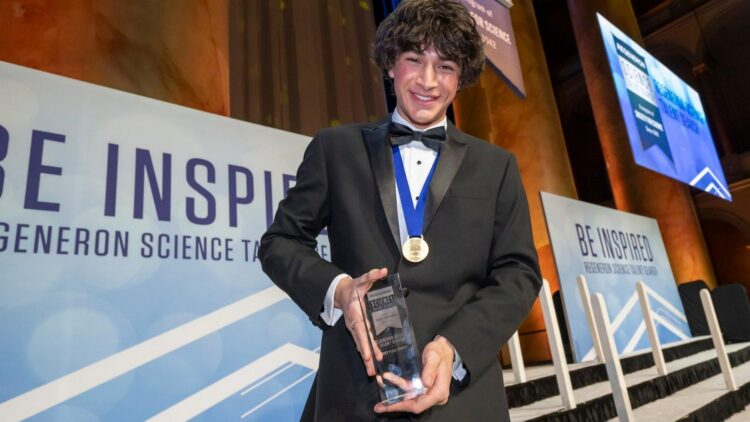
What would happen if we told you that a high school student has managed to identify 1.5 million possible asteroids using AI? Well, it is real. His name is Matteo Paz and he is a clear example that the best minds are not only found in laboratories. A 250,000 dollar prize and just one question have turned him into one of the most incredible young minds of recent years.
Data that nobody was looking at
The protagonist is called Matteo Paz, he studies in Pasadena and had access to the archives of the NEOWISE telescope, a space mission that has already been retired and was created to track near Earth objects. For ten years it collected absurd amounts of data that nobody was looking at because there was too much information. So much that reviewing it by hand was like trying to count grains of sand on a beach, something very boring, absurd, and nobody knew if it made sense. That is where Matteo said, what if AI does it?
AI to explore the galaxy
It took many hours, but Matteo managed to develop a machine learning algorithm capable of comparing images of the sky taken at different times, letting the machine detect what humans were not seeing.
And there they were, 1.5 million asteroid candidates that had gone completely unnoticed for years. Some closer, some farther away, but 1.5 million.
It is not just a technical achievement
Matteo was opening the door to investigating a new process of planetary defense. Attention, planetary defense to know if an asteroid could collide with our planet, not because aliens are invading us. And yes, at 18 years old he has already helped protect Earth.
And as if that were not enough, Matteo published the results as the sole author in a specialized scientific journal, something that is difficult even for the most experienced researchers.
Did he have help?
Of course. He is 18 years old and still in high school. The idea was entirely his, but he had the support of the California Institute of Technology, where he also received guidance from astronomers specialized in AI so that the system was not only functional but also verifiable, something that the jury of the Regeneron Science Talent Search highlighted.
The astronomy of the future
This case confirms that modern astronomy can depend on artificial intelligence and that it will clearly make things much easier for us. Webb, Hubble, and even the Gaia mission generate such enormous amounts of data that it would be practically impossible to carry out any research without AI. So, if we have this tool, why not use it?
The archives used for this project were old accumulated data that otherwise would never have been reviewed, so Matteo found a “solution” to analyze that data in record time.
The future of astronomy
Beyond asteroids, it is clear that science does not live only in laboratories, and that a lot of data can be analyzed by “anyone” with programming knowledge and a lot of curiosity, understand what I mean by “anyone”, even by a student. Matteo is an example that can encourage other students to explore the future, science, and artificial intelligence.
The universe and its surprises
Now there is still work ahead. There are 1.5 million objects that need to be verified by professional astronomers. Some will end up in official catalogs and others will simply be discarded, but Matteo has already made history with his discovery at just 18 years old.
Maybe AI does not have to be our enemy. Maybe it is our new best friend to multiply knowledge.