
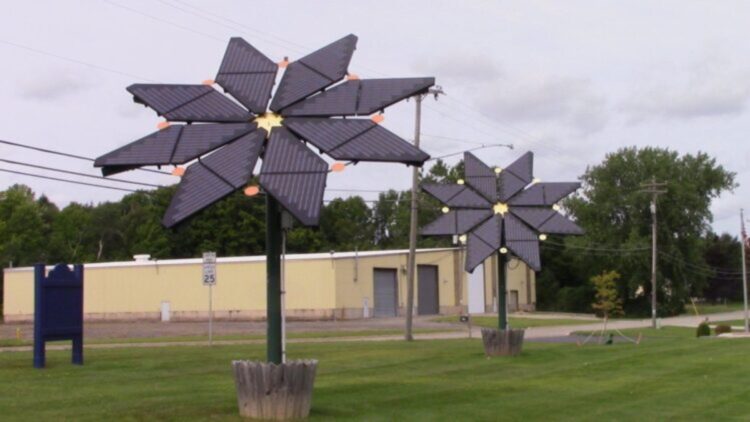
Do you think a flower can make electricity? I know it might sound like a weird question, but there are giant solar-powered flowers in the United States that look beautiful and are helping power homes using the sun! This project combines art and clean energy in a fun and creative way that’s hard to miss. Whether you’re walking by or driving through, these bright, colorful “solar flowers” are sure to catch your eye—and maybe even inspire you to think differently about how we use energy.
Flower-shaped solar panels can also be seen in South Korea, with their signature plum blossoms. However, today, we are going to focus on how these super-sized sunflowers, in the U.S., are helping the planet, one petal at a time.
Flowers that generate electricity from the sun
In a city called Sturgeon Bay, in the United States, they did something very special: they built three giant flowers that are actually solar panels. These flowers are not normal; they are made of materials that capture sunlight to produce clean electricity.
These flowers are part of a project called the Solar Flair Project (a play on the words “solar flare”). Instead of just using regular solar panels, the designers made them look like giant sunflowers and each flower has:
- 8 solar petals arranged around a yellow circle in the center (like the sun).
- Different colors: some are green, others orange, and others yellow.
- A green pole that looks like a stem and goes down into a pot.
Art + Clean Energy
The idea was to make the solar panels not only useful but also beautiful and eye-catching, so that people become more interested in renewable energy (like solar or wind, which do not pollute).
These solar flowers produce enough electricity to power a small house for a year. They are huge: they measure about 5 meters wide and weigh more than 500 kilograms each. They can also move to follow the sun during the day, to capture more energy.
Why did they do this?
The city’s energy company, Sturgeon Bay Utilities, wants to take care of the planet by making environmentally responsible choices and encouraging the community to do the same. How will they do this? Sturgeon Bay Utilities offers a program called Choose Renewable that gives residents the option to power their homes with renewable energy instead of fossil fuels. It’s part of the company’s larger effort to support clean air and water, protect public health, and create a more sustainable way of living. Through this program and others like it, they hope to make renewable energy easy and accessible for everyone in the community.
What should we learn from this?
What this shows us is that art and science can work together in powerful ways—turning something as technical as solar panels into something creative and inspiring. It also reminds us that clean energy isn’t just a concept for the future; it’s something we can use right now to help take care of the planet. And perhaps most surprisingly, it proves that even something as simple as a flower—when powered by the sun—can make a real difference.
So, next time you see a solar panel—or even a flower—think about the possibilities it can have. We live in a world where technology is so advanced that almost anything can be created. I mean, it is nice to see solar panels in a different, more eye-catching way that contributes to the aesthetic of the places. Don’t you think technology and environmentally-friendly options should go together? We will see if designers come up with new ideas for more solar panels.