
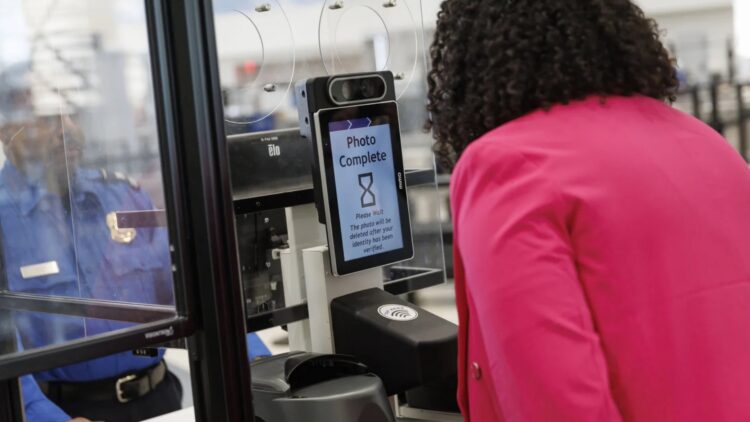
If you have traveled by plane lately, you may have noticed that going through security is no longer what it used to be a few months ago. Now, it is as simple as letting them scan your face (like unlocking your iPhone) and you can automatically pass through. This measure has generated a lot of controversy among travelers, which we will tell you about, but what many do not know is that it is legal and legitimate to refuse facial recognition at airports.
That’s right, more and more travelers have found themselves facing a “look straight ahead, please” and a camera in front of their face, but the truth is that you are not required to use it, and if it makes you uncomfortable, you can refuse, and there will be no consequences.
Few people know
This system has been introduced in recent years in more than 80 airports across the country, and the TSA plans to reach more than 400 in the coming years. Its goal is to speed up the process and verify your identity by comparing your face to the photo on your document, something that, at first glance, seems harmless.
But many people have wondered what happens to the photos of your face afterward (especially knowing what AI does now, data sales, etc.).
The TSA claims that the photographs are deleted after a very short period of time (except in locations where testing is being done), but several privacy experts (and even internal documents from the Department of Homeland Security itself) do not trust this process at all…
“The benefit of refusing the scan is that you avoid giving your image to the government to analyze or store under its own rules,” explained Travis LeBlanc, former member of the Privacy and Civil Liberties Oversight Board.
And of course, when you hear things like that, you start to wonder to what extent these images could later be used for surveillance or tracking… especially knowing how things are, for example, for migrant people.
Security or hyper-surveillance?
The TSA insists that its system does not track people or share data, it only compares it with the image already in the record. However, other federal agencies (Customs or CBP) do store images of foreign travelers indefinitely.
“The TSA’s public communication is very vague about what they actually do with that information,” said Jennifer King, a data policy researcher at Stanford University. “The dream of any security agency would be to be able to track people in real time through facial recognition.”
It’s not that this is already happening (at least officially, we believe), but the lack of transparency makes many see it as one more step toward a mass surveillance system, and obviously, nobody likes that.
Can I refuse the scan?
Of course, and not only that, you just need to say that you want to use the manual method.
The TSA officer must then verify your identity the traditional way: by looking at your document and comparing it with you. They cannot penalize you, and they should not make you wait longer either.
That said, some travelers have reported that staff sometimes try to discourage them by saying that refusing could cause delays, but they should not, because you have the right not to be photographed.
Sara Hussain, from the Electronic Frontier Foundation, believes the message should be collective; she chooses not to participate in facial scanning. She thinks that as citizens, we should send a collective message by refusing facial scans so that the TSA reconsiders its technologies.
And now?
For the moment, it is not mandatory for U.S. travelers, but it might be for foreign nationals on international flights, and there begins another dilemma: is privacy a right… or a privilege?
The TSA has hinted that it plans to expand the use of biometrics to all checkpoints, connecting these systems with federal databases, and perhaps then it will be more difficult to refuse in the future.
For now, if you are not comfortable knowing that your photo could be in databases across the country, you can refuse and have an officer verify that your document belongs to you. As long as we do not know what is really done with our data, better to go old-school, right?