
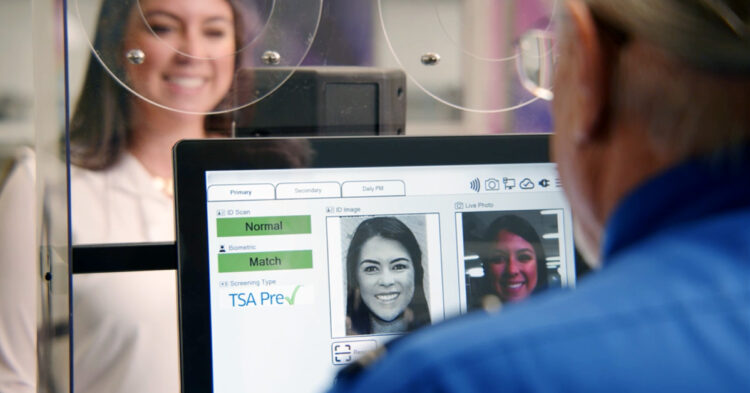
You’re going on a trip. You pack your bags, prepare your liquids in that annoying bag making sure none exceeds 100ml, go through the scanners and, suddenly, the TSA asks you to look at a camera that takes a picture. What? The TSA has expanded the use of facial scanning in many of its airports as part of its routine security checks, claiming this system speeds up and improves data verification. But did you know that you can refuse to have your face scanned?
Yes, we’re in the middle of the tech and biometric era (like what we have on our iPhone) but these scans, even if they are voluntary, could put your fundamental rights at risk! Here’s why you should consider not participating and how to do it without losing your place in line.
What is TSA facial scanning?
Let us explain. Since around 2020, the Transportation Security Administration (TSA) has incorporated facial recognition technology in more than 80 airports across the country. The system is simple. It takes a photo at the checkpoint and compares it with the image on your ID. If it matches, you can go ahead. Seems easy. In principle, it’s a voluntary program, at least for U.S. citizens flying within the country.
Is it really optional?
That’s what they say… but many travelers say they’ve been allowing their faces to be scanned for years because it’s not clearly stated that it’s optional at the checkpoints. Signs are hard to see, written in only one language… Many confused users end up submitting to the scan believing it’s a mandatory measure.
Jennifer King, a privacy expert from Stanford University, warns that the agency does not clearly communicate how it uses the data collected. This has raised alarms among civil liberties advocates. What do they want your facial data for?
King believes law enforcement agencies dream of tracking people in real time using facial recognition.
What happens with the photos TSA takes?
The agency claims it does not store the images if the photo matches the document. However, other entities like Customs and Border Protection can keep the photos for up to 12 hours if you are a U.S. citizen, or indefinitely if you are not.
What do privacy advocates say?
Travis LeBlanc, former member of the Civil Liberties Oversight Board, believes the most worrying part is the possibility of using this tool to track people in real time or link it to other government databases.
LeBlanc and two other board members were fired by the Trump Administration this past January and are now suing for wrongful dismissal. Could this have something to do with the complaint he’s making about the information the government stores about its citizens?
How can you refuse facial scanning?
Don’t be afraid. If you don’t want your photo taken, you can tell the agent out loud: I want a manual ID verification.
Of course, this should not delay you or remove you from the line, and TSA confirms that standard procedures must continue. Some users have reported being told the scan was mandatory, but they stood their ground without consequences. If this happens to you, quickly look up the scanning policy because, as we’re saying, it’s not mandatory.
What if I’ve already been scanned before?
Even if you’ve already gone through this system, you can start refusing it on your next trips. Every checkpoint is different from the last, and it’s a new opportunity to defend your rights. There needs to be resistance to stop the continued implementation of these invasive technologies.
The future in airports
What will it be like? For now, it seems they plan to expand these systems to more than 400 airports, but since it’s not mandatory yet, you can always refuse, and if travelers don’t show concern, TSA will continue deploying these tools without much oversight. That’s why every refusal matters.
Remember that your privacy is at stake. What do they want your facial data for? Saying no to facial scanning is not only a right, it’s also a way to draw a line in front of a system that keeps advancing without brakes!!!