
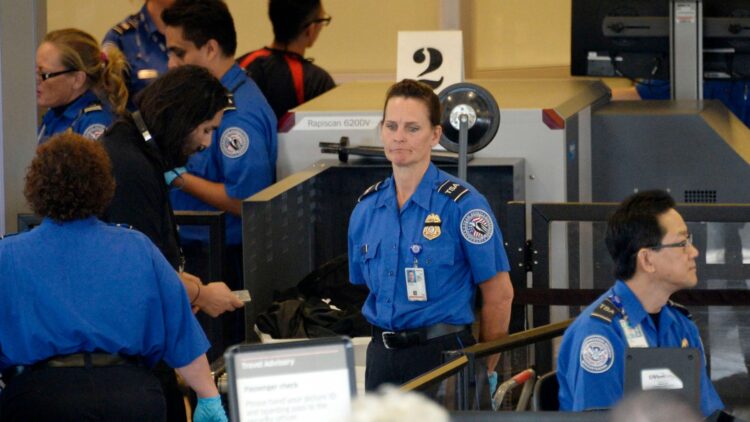
The TSA is reviewing its rules and finally some of the most annoying ones are starting to relax. Finally the thing about taking off your shoes at checkpoints is over (it was very annoying, right?) and everything indicates that soon the liquid restrictions could also disappear thanks to the arrival of new technologies, this is the one that most motivates us to travel!!! While passengers celebrate, the TSA is at the center of the debate for its privacy issues and facial recognition…
Just in 2023, more than 858 million people (!!!) passed through airports in the U.S., a record that makes clear how necessary security is at an airport, but they need to be fast too, don’t you think so?. Two decades after marked by 9/11, 2025 wXants to bring changes and more comfortable controls… but here arrives the controversy, of course!.
The role of REAL ID
Since May, all domestic flight passengers must present a REAL ID or an equivalent document (as a passport) in the TSA control, it was created to unify requirements in the national territory and prevent identity theft.
Some “trusted traveler” programs like (TSA PreCheck, CLEAR or Global Entry) allow travelers to go through the checkpoint more quickly, they do not have to take off their shoes or remove laptops or liquids from the suitcase (the real “if only”). This way, fewer resources can be spent on those who have already shown not to be a “risk”.
Facial recognition
This is probably the most debated point of the latest TSA changes. For many people, it is the future, faster lines, much more accurate identifications, just with a selfie! But others believe they are trying to create a surveillance system in which passengers lose control over their own identity…
And the reality is that this type of system makes more mistakes with certain ethnic groups, which can end in unfair delays or even discrimination. The TSA assures that the use is voluntary, but it is not always clear that the traveler can refuse without problem…
Electronic devices
And maybe you didn’t know that cell phones and laptops can be inspected at checkpoints (even if there are only photos of your cat inside, yes), and no, a court order is not required, so this fuels the debate about finding a balance between national security and respect for privacy.
No-fly list
Matteo Garofalo (from the Francis King Carey School of Law at the University of Maryland) has stated that people of Islamic or North African heritage are overrepresented on the no-fly list, this means that this list is quite discriminatory toward a specific ethnic group and that they are reinforcing prejudices…
What is coming in the next months
If there is an expected change, it is the liquids one!! The 100 ml rule could be coming to an end (please) thanks to a new, more precise scanners, capable of detecting dangerous substances without forcing the traveler to divide shampoos and gels into small bottles.
In the meantime, the TSA will continue to strengthen programs like PreCheck and fine-tune the use of biometrics. Of course, the debate about how much privacy to give up in exchange for security will remain very alive…
Airports in the U.S. are (finally) changing. Goodbye to taking off shoes, goodbye soon (maybe) to the 100 ml bottles, and welcome to technology that promises faster controls. But each advance opens new questions: are we safer or more watched?