
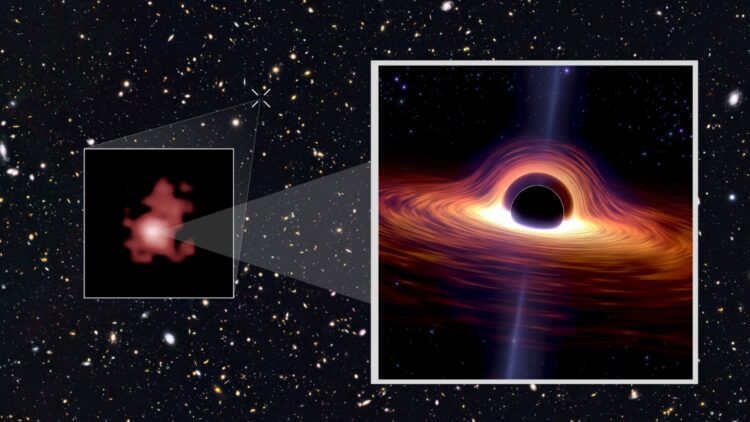
Another shocking scientific discovery! The most ancient black hole found by the James Webb Space Telescope is revolutionizing everything we knew about the creation of galaxies and black holes. This finding was hidden in a small galaxy of more than 13,300 million light years.
These are the most mysterious elements of the universe, and this one is changing the game of theories about the universe. So, let’s find out more about this discovery and why it’s so important.
The cosmic past
When astronomers use the James Webb Space Telescope, they are not just looking at space, they are also going back in time. How could this be possible? Well, the light of the far away galaxies lasts thousands of millions of years to reach us. That’s why what we see is how it was a very long time ago.
In this case, scientists found a supermassive black hole that already existed when the universe was just around 500 million years old, basically its childhood. The galaxy where the discovery was found was named CAPERS-LRD-z9, but it has a nickname: Little Red Dot. I mean, much easier, right? And if you were wondering why this nickname, it’s because it looked like a reddish spot on the telescope data.
Why is this black hole so surprising?
The most striking thing about it is its size. Researchers estimate this black hole is between several million and up to 300 million times more than the Sun’s mass. Here comes the trouble, because some current theories say that black holes are created when huge stars die and, step by step, they get bigger when absorbing nearby gas and stars. However, this growth takes time, so how is it possible that in just 500 million years such a huge black hole already existed? Let’s find out.
Possible reasons
To give an answer to this mystery, astronomers have two possible theories:
- Light seeds: small black holes are created from the first stars. So, to fit this finding, they would have grown so much faster than we thought (maybe absorbing gas at a ‘’super-Eddington’’ rhythm).
- Heavy seeds: black holes that are already big when formed, from the direct crash between huge gas clouds. In this case, the Little Red Dot would have had a very special beginning, different to most of the galaxies.
None of these theories are very convincing, and that’s why this black hole is making astronomers rethink our models about the primitive universe.
Little Red Dot galaxy
What’s also curious about this supermassive black hole is that it lives in a tiny galaxy. The Little Red Dot has less than thousands of millions of solar masses in the shape of stars, which is so little in comparison to other known galaxies. However, its black hole is overwhelmingly big: more than 4.5% of the total mass of the galaxy, while in the current universe this proportion tends to be barely 0.1%.
In addition, the galaxy is covered in a gas cloud, which explains its reddish color. This could also expand the black hole’s brightness, making it stand out even more.
A new type of objects
The Little Red Dot is not an isolated case, thanks to the James Webb Space Telescope, astronomers are finding more galaxies like this one: compact, red, and very bright objects. Most of them seem to hide active black holes inside.
This is shocking because, until now, it was thought that supermassive black holes were rare in the early universe. However, these findings suggest that they were more common than expected.
A challenge for cosmology
The discovery of the most ancient black hole makes us change the way in which we understood the growth of the first cosmic structures. I mean, who is surprised about this? With every discovery coming from space we have a more clear idea that the universe still hides many secrets.