
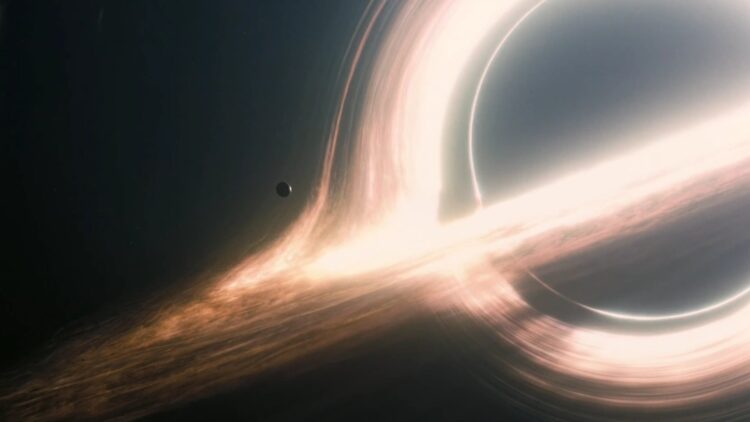
We have always seen black holes as the great mystery of the universe. What are they, where do they come from, where the hell do they take what they swallow? But now, suddenly, something shows up that steals the spotlight: white holes. Yes, it sounds like a movie script. But it isn’t.
Einstein already sensed it…
Even if it sounds crazy, NASA has started to find signs pointing in that direction. And the most curious thing is that Einstein already hinted at the possibility more than a century ago with his general theory of relativity. The funny thing is that even he wasn’t comfortable with that idea: according to his own equations, there could be a region in space where time and matter behave exactly the opposite of a black hole. That is, instead of absorbing everything, it would spit it out violently.
So what is a white hole, then?
The idea is simple: it’s the opposite of a black hole. If one swallows light, matter and even time itself, the other does the opposite: it spits all that out violently. Just like that, unfiltered. For years, this was thought to be pure theory, something too fanciful to take seriously. But with advances in quantum physics and new telescopes, that kind of shelved ideas are starting to be dusted off.
And here comes the interesting part: some models suggest that a black hole, over time, could turn into a white hole. And yes, that would mean that the matter and information swallowed don’t disappear forever, but could eventually come out at some point.
What NASA is detecting
In recent years, NASA and other agencies have started to receive strange signals. Gamma-ray bursts, gravitational waves that don’t seem to have an origin, radio bursts that don’t match anything known. And the most puzzling part: many come from completely empty areas of the universe. Places where there are no stars, no black holes, nothing.
So, what’s happening there? Could they be white holes exploding, being born, or simply working in ways no one expected? There’s no definitive proof yet, but the anomalies can’t be ignored anymore.
A door to time or other universes?
This is where Marvel mode kicks in. One of the strongest theories is that black holes and white holes are connected through a wormhole. A tunnel in space-time. If this were real, we’d be talking about a natural path to travel through time or even reach other universes.
And the best part is that the math behind this doesn’t fail. Everything fits, at least on paper. The problem, as always, is that no one has been able to see one directly. But if the signals keep appearing and there’s no way to explain them with what we already know… something is going to change.
Why this matters (a lot)
Searching for white holes isn’t some nerdy obsession of physicists. If they really exist, they could give us key answers about how the universe works. How it’s born, how it dies and if it has any real limits. It would be a giant step in our way of understanding the cosmos.
That’s why NASA keeps watching closely. Analyzing data, cross-checking satellite records, sharing info with observatories all over the planet… and waiting for the moment of confirmation.
What if Einstein is right again?
Well, it wouldn’t be the first time, right? For decades, the idea of white holes sounded too far-fetched. But now, with today’s technology and the data coming from the edge of the universe, what once seemed impossible is starting to take shape.
If one day their existence is confirmed, we won’t just be validating another of Einstein’s crazy ideas. We’ll be opening the door to a new way of looking at the universe. And maybe, deep down, that’s the most exciting part of all this.