
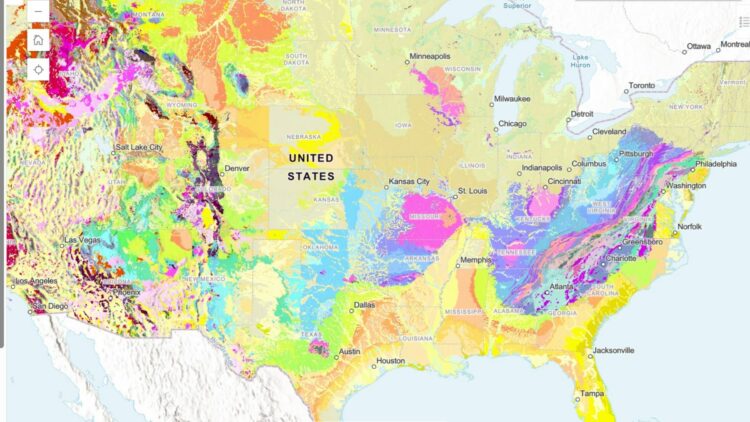
Have you ever thought about what is under your house? We’re not talking about the supermarket or that candy store, we mean something deeper, like underground. What materials is the ground you walk on made of… Doesn’t it sound interesting? Well, now the United States Geological Survey (USGS) has just created an interactive map that shows, in full detail, the geological history of the country. That is, the types of rocks and sediments that exist and coexist beneath your feet! We love the idea.
The project was presented last August and unifies more than one hundred regional maps so that we can observe the planet’s past, and yes, it is available to everyone!
A look at the planet’s past
Behind this project is Joseph Colgan, a USGS geologist who wanted to unify the geological information of the 48 continental states so that any citizen could understand how the place where they live was formed. And this is the result, of course. In this map, you can observe how landscapes were shaped, how water flows underground, or whether the rocks beneath your feet are hard, fragile, or very old.
Each color on the map represents a different age or composition: recent sands, sedimentary rocks, ancient granites, or river deposits.
Beyond its academic value, this tool could help scientists, engineers, and urban planners make decisions about where to place certain buildings.
What does the map show?
The map classifies soil layers according to their age and composition and goes as far back as the Precambrian era (one of the oldest stages). This way, they can identify seismic zones, unstable terrain, or even underground aquifers.
“Geological maps help identify energy, mineral, and water resources, as well as assess risks such as earthquakes or landslides,” explained Christopher Swezey, coordinator of the USGS National Cooperative Mapping Program.
In other words, it helps to discover oil and to decide where not to build a house.
Technology and a new era of exploration
Updating a geological map used to be madness… until now. This modern methodology standardizes old maps into a database that can be updated in real time, a marvel.
“With this method, we can update the national map faster than ever,” said Sam Johnstone.
In addition, the digital interface makes it easy to consult from any device. Students, researchers, or curious users can go to the USGS website, click on any point on the map, and see information about the age, type of rock, and its origin!
More than science
According to a national analysis, every dollar invested in geological mapping generates between 7 and 10 dollars in economic return, thanks to better decisions in construction, mining, and water management. Also, by having accurate data about the subsoil, it helps prevent geological and atmospheric disasters, saving thousands of lives and millions of dollars in infrastructure.
The USGS also believes that this tool can be used in schools to teach how the Earth works and how it was formed, and governments can use it to manage resources and mark risk areas.
How to access the map
The map is available for free on the official USGS website. From there, users can explore geological materials, switch between temporal layers, and download data for scientific or educational projects.
It is also possible to connect the map to geolocation programs (GIS).
For now, the tool covers the 48 continental states, but the USGS has already confirmed that Alaska, Hawaii, and the U.S. territories will soon be included.
Science within everyone’s reach and right under our feet, doesn’t that sound incredible!? Check this link to enter the USGS website, enjoy!