
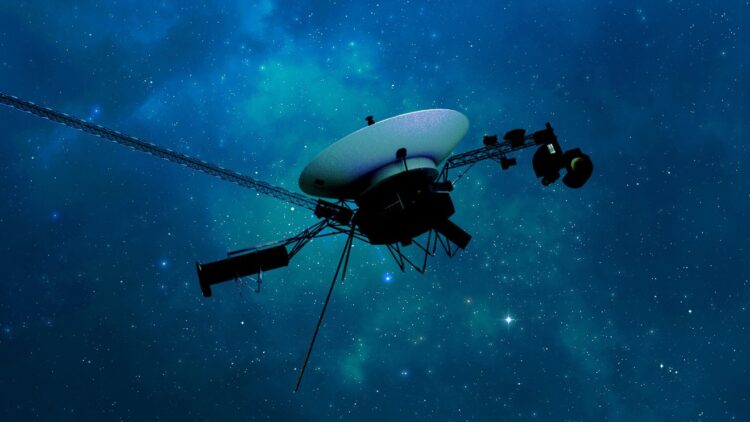
It’s been half a century in space but refuses to die, Voyager 1 has surprised the scientific community after recovering some thrusters that were considered lost in 2004! Against the clock and risking its own “life” because it was executed just before the only antenna that could communicate with it went into maintenance.
But no, it’s not a miracle! It was a brilliant move by the engineers at the Jet Propulsion Laboratory (JPL), who combined calculations, technical memory, and trust in the probe that has become a living legend of space exploration!
What is Voyager 1
Surely it rings a bell, it’s an unmanned space probe that was launched from Earth in 1977! NASA was the one who went all in on this probe, and its goal was to explore the outer planets of the solar system. So much so, it’s the human-made object that has travelled the farthest, it’s now travelling through interstellar space (beyond the light of our Sun).
Also, here’s our favourite fact: Voyager 1 carries a record with information about Earth in case it encounters an unknown civilization. For example, it includes greetings in 55 different languages (just in case aliens speak Sumerian), natural sounds from our planet, and a music selection with various folk songs from different cultures and classical works by Beethoven, those couldn’t be left out.
And what has this probe done?
Let’s keep in mind that it’s 25 billion kilometres away from Earth, travelling at 56,000 km/h just to keep its main antenna pointed at us and be able to send us the data it records. To do this, it uses three types of movement: pitch (up and down), yaw (left to right), and “roll”, the last of which allows the spacecraft to spin on its own axis to orient itself and calibrate its magnetometer.
Well, these roll thrusters hadn’t worked for over 20 years, with their fuel frozen and the spacecraft’s nozzle unusable.
At the time, NASA decided the failure was irreparable and switched to the backup thrusters because they didn’t think Voyager would still be a champion 20 years later.
What happened 20 years later?
Logically, the lines of the backup thrusters also began to clog, putting the entire mission at risk because it would make it impossible to keep receiving data from it.
The Voyager team, led by Kareem Badaruddin, reexamined the 2004 failure looking for an emergency rescue plan. But… could they fix it before the Canberra antenna went into maintenance?
The rescue plan
The engineers reanalysed the failures of the original heaters and suspected it was “a simple switch in the wrong position” and that if they corrected that, they could turn the heaters back on, and therefore, the original roll thrusters.
Risky? Of course. If the plan didn’t work, the frozen fuel could explode and damage the probe. Was there another option? Then let’s go for it.
Command sent… and now?
Once the engineers sent the command, they had to wait 48 long hours to find out if it had worked, almost like childbirth. On March 20, telemetry with the results began to arrive… And the plan had worked (applause, applause!)
What does this mean?
That Voyager 1 doesn’t want to die so young, it still has a lot of space left to travel. When the backup thrusters fail, the newly recovered ones could be used to continue generating information about the space beyond our planet. It’s as if they roared back to life after 20 years in the garage… millions of kilometres from home!
Of course, this story leaves us with many takeaways, how important it is to never give up! Thanks to that determination, humanity still has a voice travelling through space, far beyond where our imagination can reach! Safe travels and long life, Voyager 1!