
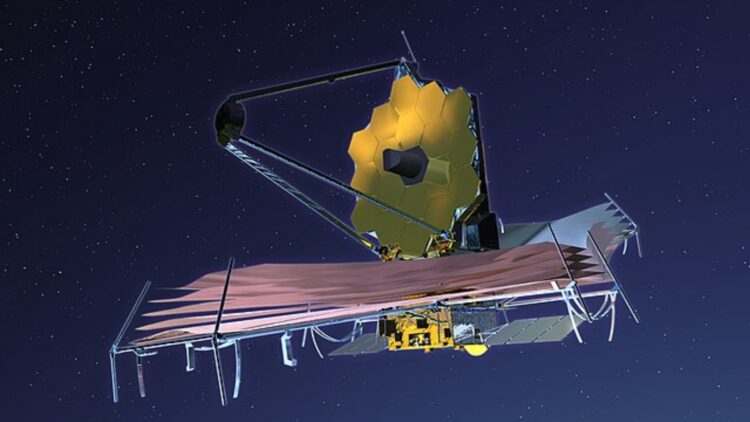
Just when astronomers think they have a clear understanding of how the universe works, NASA comes along and shakes up their theories. It seems impossible to have any clarity about what’s going on up there, but thanks to the James Webb Space Telescope, a disk of gas and dust has been discovered around a 30-million-year-old star, something that has completely challenged our understanding of planet formation! Until now, scientists believed that these disks only lasted about 10 million years before dispersing, but this discovery changes everything.
What’s going on up there?
Let’s use our imagination: if the universe had a photo album, its pages would be filled with images of disks of gas and dust orbiting young stars: veritable cradles of planets in formation. Until now, it was believed that these planetary nurseries had a fleeting existence, lasting approximately 10 million years before dispersing.
But the University of Arizona has changed the picture. It turns out that, around tiny stars, with barely a tenth the mass of the Sun, these disks can persist much longer than expected.
A disk that breaks cosmic rules
Researchers at the University of Arizona, led by Feng Long, have found a protoplanetary disk around a low-mass star called J0446B, located 267 light-years from Earth. The surprising thing is that this disk is still intact after 30 million years! This means that these systems could have much longer to form planets than previously thought, three times older than what science considered the usual limit.
According to the study published in The Astrophysical Journal Letters, the Webb telescope detected large amounts of primordial gas in this disk, confirming that it is not a simple “leftover” of material, but an active environment where planets could still be forming. As Long explains, these disks are like photo albums of planetary systems in their infancy, revealing secrets about our own cosmic past.
Are they still searching for life on other planets?
Of course! This discovery could also explain why some planetary systems, like the famous TRAPPIST-1, have so many rocky planets in their “habitable zone.” If these disks of gas and dust can last three times longer than expected, then there’s more time for planets to form, evolve, and maybe, just maybe, develop conditions suitable for life. According to the researchers, these types of low-mass star systems are much more common in the universe than those similar to the Sun, which means there could be many more planets in the Milky Way with ideal conditions for life.
Chemical discoveries
The chemical composition of the disk has not changed much over time. This indicates that these disks do not “wear out” or transform rapidly, giving forming planets a stable environment in which to develop. In other words, astronomers have detected the presence of gases such as hydrogen and neon, demonstrating that this disk is not simply a “graveyard” of stellar material, but is still active and evolving, opening the door to dozens of investigations.
Absolutely nothing up there leaves us indifferent. Every day, and thanks to NASA and the James Webb Astronomy Observatory, we’re learning things you’d never have imagined before. With each new discovery, our understanding of what’s up there seems to explode, but it opens up new avenues of research and, above all, the possibility of finding life on other planets! Who knows, maybe in a few years we’ll see the first space mission in search of habitable planets!