
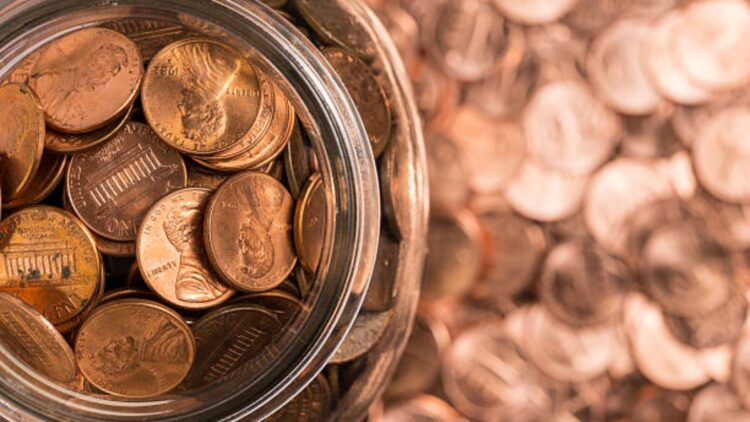
Change or treasure? We already tell you that the little coins you get back from buying bread could be a real treasure. In that piggy bank where you keep all the leftovers you could have one of the Wheat Pennies, Lincoln wheat cents, some of the most sought-after coins by coin collectors (yes, there are people who collect coins!) and beyond sentimental value, some editions of these coins have been auctioned for more than $100,000! Maybe you think they are normal coins, but no, they are rare edition coins and they can make you rich.
Especially the cents minted between 1909 and 1958, the most sought-after series in numismatics because they are history of our country! Do you dare to search among your coins?
What are Wheat Pennies
Wheat Pennies are coins recognized by their design: the portrait of Abraham Lincoln on the obverse and two wheat stalks on the reverse. Their creator was Victor D. Brenner, who included his initials “VDB” on the first 1909 runs, which generated a bit of debate (we love that, you know it) and turned those coins into a particularly coveted specimen.
Why are they worth so much money?
Because they are special, they are not just coins. Their value depends on three factors: year of issue, mintmark and state of preservation (perhaps one of the most important things when we come across one of these coins).
These coins are usually very limited, others have minting errors… All that makes their level go up and there are people who pay a lot to have one of these.
Examples of key pieces
- 1909-S VDB: first year of issue with the designer’s initials, valued between 700 and 1,500 dollars.
- 1914-D: minted in Denver and can reach 500 dollars in medium condition.
- 1943 copper: one of the most famous errors, accidentally minted in copper when they were already made of steel, its value exceeds 100,000 dollars.
- 1955 double die: very evident minting error, priced between 1,000 and 2,000 dollars.
How to identify a valuable Wheat Penny
It is important to check all the details of the coin, if it marks “D” for Denver and “S” for San Francisco, or no mark for Philadelphia.
Then, experts advise using a magnifying glass to look for possible design errors, such as duplicated numbers or missing mintmarks.
The state of the coin is also essential to calculate its value, this is measured with the Sheldon scale, which goes from “Good” (very worn) to “Mint State” (as if it just came out of the mint). A well-preserved coin can multiply by 50 the base value of a common specimen, so take care of them!
| Condition (Grade) | Description | Value Multiplier |
| Good (G4) | Heavy wear, date visible | Base value |
| Fine (F12) | Moderate wear, details visible | 2×–3× base |
| Extremely Fine (EF40) | Light wear, clear details | 4×–6× base |
| Mint State (MS60+) | No wear, full luster | 10×–50× base |
Tips for collectors
Experts recommend never cleaning coins at home if you do not have specific knowledge, because it could reduce their value, and also advise storing them in sleeves where they are not in contact with anything acidic.
For those who have specimens they believe are valuable, the best is to send them to certification services like PCGS or NGC, which verify authenticity and condition, or maybe go to a coin expert if you do not trust sending it by mail. That said, never stick with the first opinion and never accept the first price, keep investigating and stay with the one that suits you best!
More than old cents, they are part of our history and, as you see, in some cases they are worth a lot of money! The world of coins is incredible and continues to awaken passions among collectors and curious people, have you already checked your pockets today?