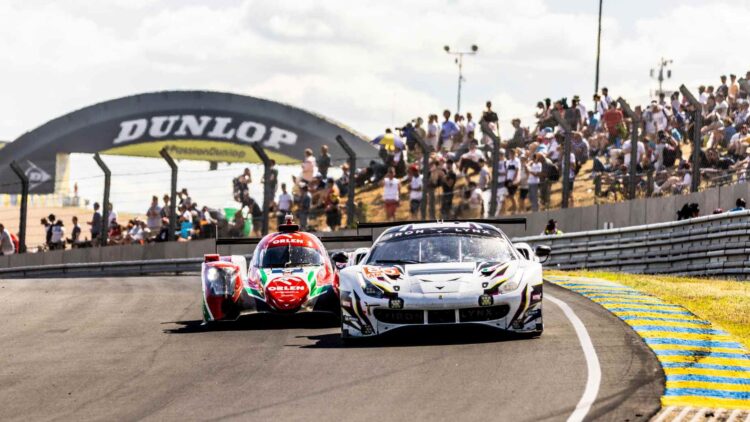
Ford famously won the 24Hours of LeMans outright in 1966 and 1969. The first one of which was a contested race, full of years of disappointment for the manufacturer, that was later represented on the big screen with Ford vs Ferrari. And after sitting out the race for 60 years, Ford returned with the second-generation GT to win in the former GTE Pro series (now GTLM) that was designated for GT3-capable race cars that are based on production models and with professional drivers.
And while Ford is planning on competing in the GTLM series with a Mustang GT3. Ford is aiming for an outright win in 2027 LeMans with an LMDh. The top level of the competition, including brands such as Alpine, BMW, Cadillac, Peugeot, Porsche, and Toyota.
“Ford has been synonymous with success both on and off-track for decades, and we are delighted that the company has chosen the FIA World Endurance Championship for its latest challenge,” Frédéric Lequien, CEO of the FIA World Endurance Championship said in a statement. “To have at least ten major automotive brands committed to the series’ top tier in 2027 is a testament to the championship’s stellar momentum and growth.”
Announcing the new entry on the LMDh series on Thursday makes the World Endurance Championship the second competition entry from the blue-oval since they announced a technical partnership with the Formula 1 team RedBull Racing as an engine partner starting the new cycle of regulations in 2026.
How does the new top-class vary from the previous LMP1 prototypes and what will make them win in LeMans?
The FIA has been trying to reduce the costs for manufacturers running in LeMans, a worry that became a reality when Toyota was the sole hybrid manufacturer running on top. So the FIA opened the Hypercar class to two denominations LMDh (LeMans Daytona hybrid) and LMH (LeMans Hypercar). Both categories will be able to also run in the IMSA SportsCar Championship.
This cost reduction and the balance or performance rules is allowing Ford to enter with a full factory team. Ford will have to use a supplied chassis from Dallara, Ligier, Oreca or Multimatic. Although Ford is expected to use Multimatic as the Canadian firm has already built for Ford the chassis for both road and racing versions of the second-generation GT. Putting Ford up against Porsche to be the top Multimatic chassis
Powertrain is where the manufacturers can sneak out a slight advantage. Teams are relatively free to choose the powerplant, but power must be limited to 670 hp and the rear-axle hybrid system needs to use specification parts from Bosch, WAE and Xtrac.
In both cases of LMDh and LMH there is a minimum weight of 1,030 kg (2270.7 pounds) which can be adjusted up to 50 kg (110 pounds) up or down depending on Balance of Performance rules. LMH are the closer ones to the “traditional” LMP1 prototypes, where manufacturers design and build everything. LMDh was a class the, while it is possible for them to win outright, it’s an evolution of the known as LMP2 category (slower and cheaper to manufacture prototypes thanks to a few manufacturers providing componentry) and a compromise for the evolution of the DPi cars in IMSA. Both categories are now hybrid and have the same maximum power limitation, but there are differences on how the electric power is applied in terms of deployment and speed of the vehicle. The only non-hybrid car on the hypercar grid will be the Aston Martin Valkyrie, which will also be the only Naturally Aspirated V12 powered car.
All these measures have allowed manufacturers to build hypercars for a massive discount compared to LMP1 prototypes. About an 80% discount at that. And that has been reflected in the amount of manufacturers that are currently listed for the 2025 24hours of LeMans; Aston Martin, Porsche, Toyota, Cadillac, BMW, Alpine, Ferrari, and Peugeot. A total of 18 cars that will battle it out for the top step of the podium.